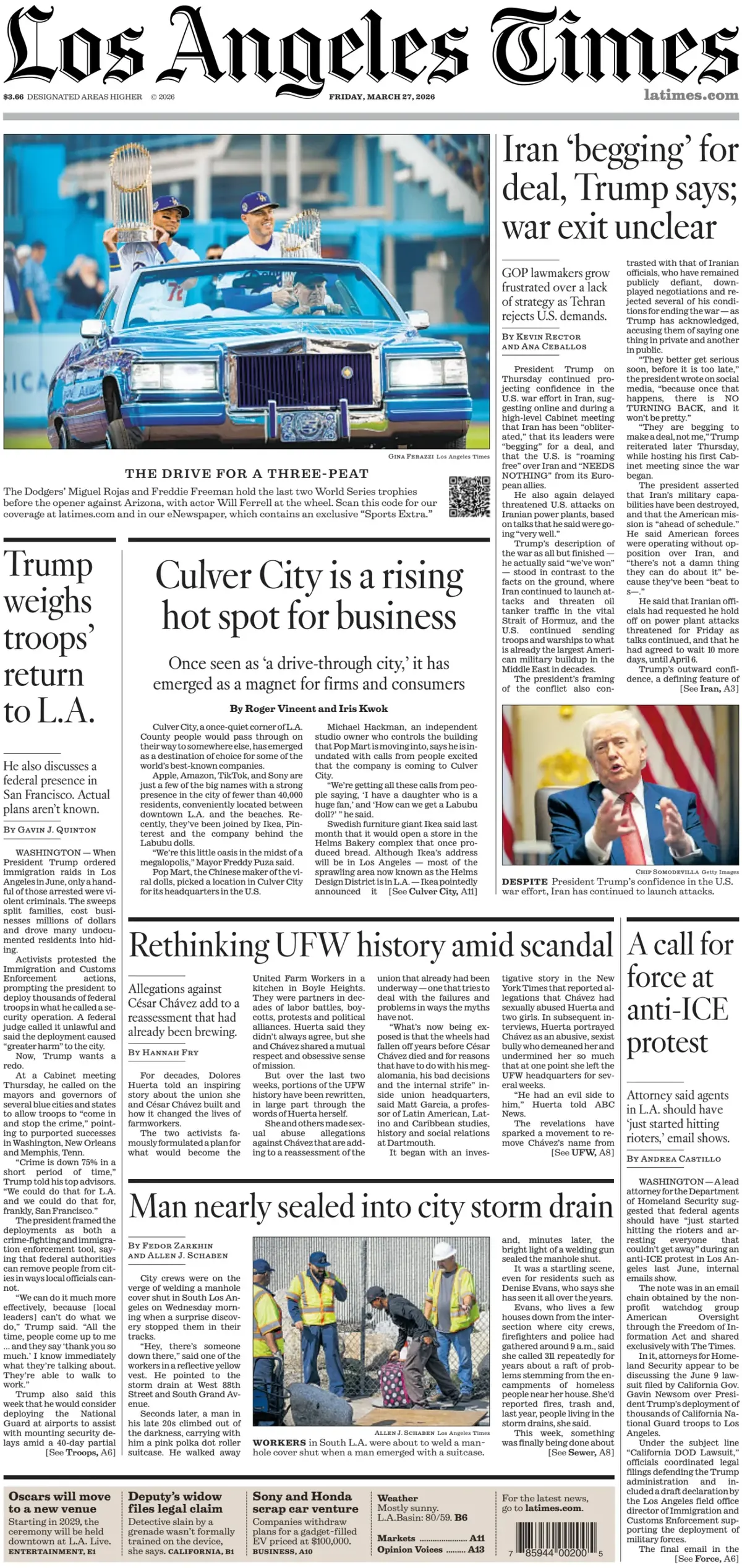
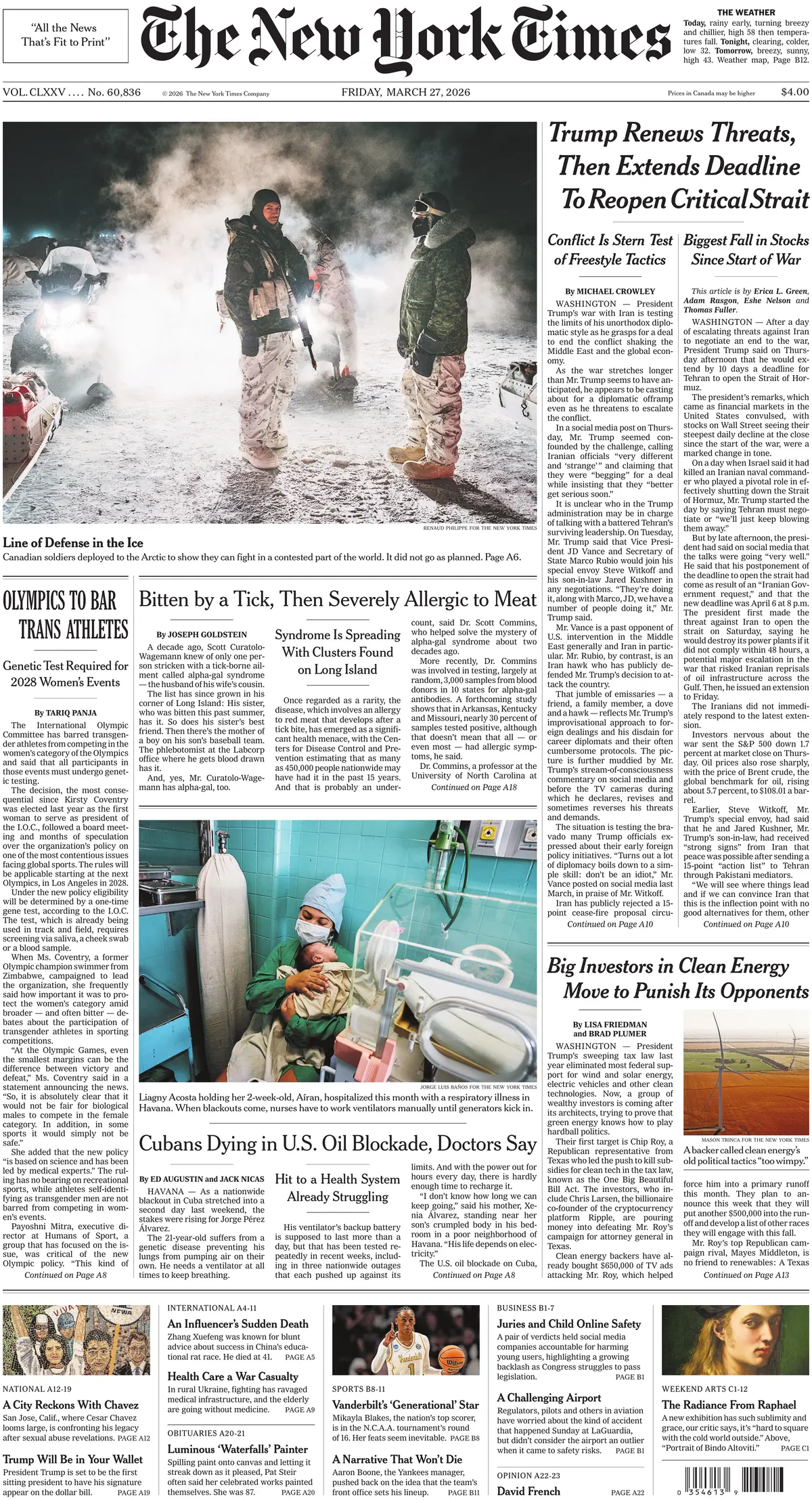
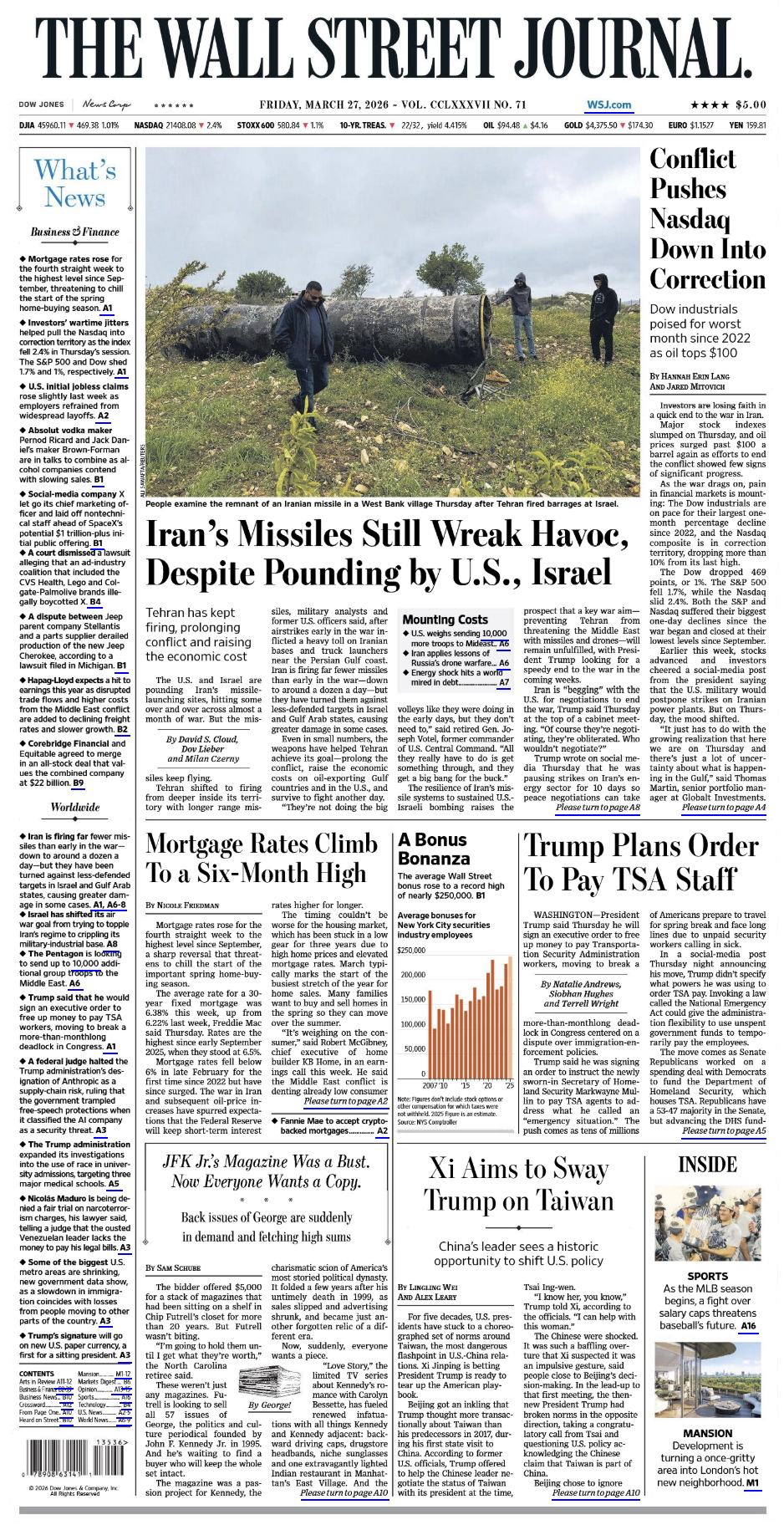
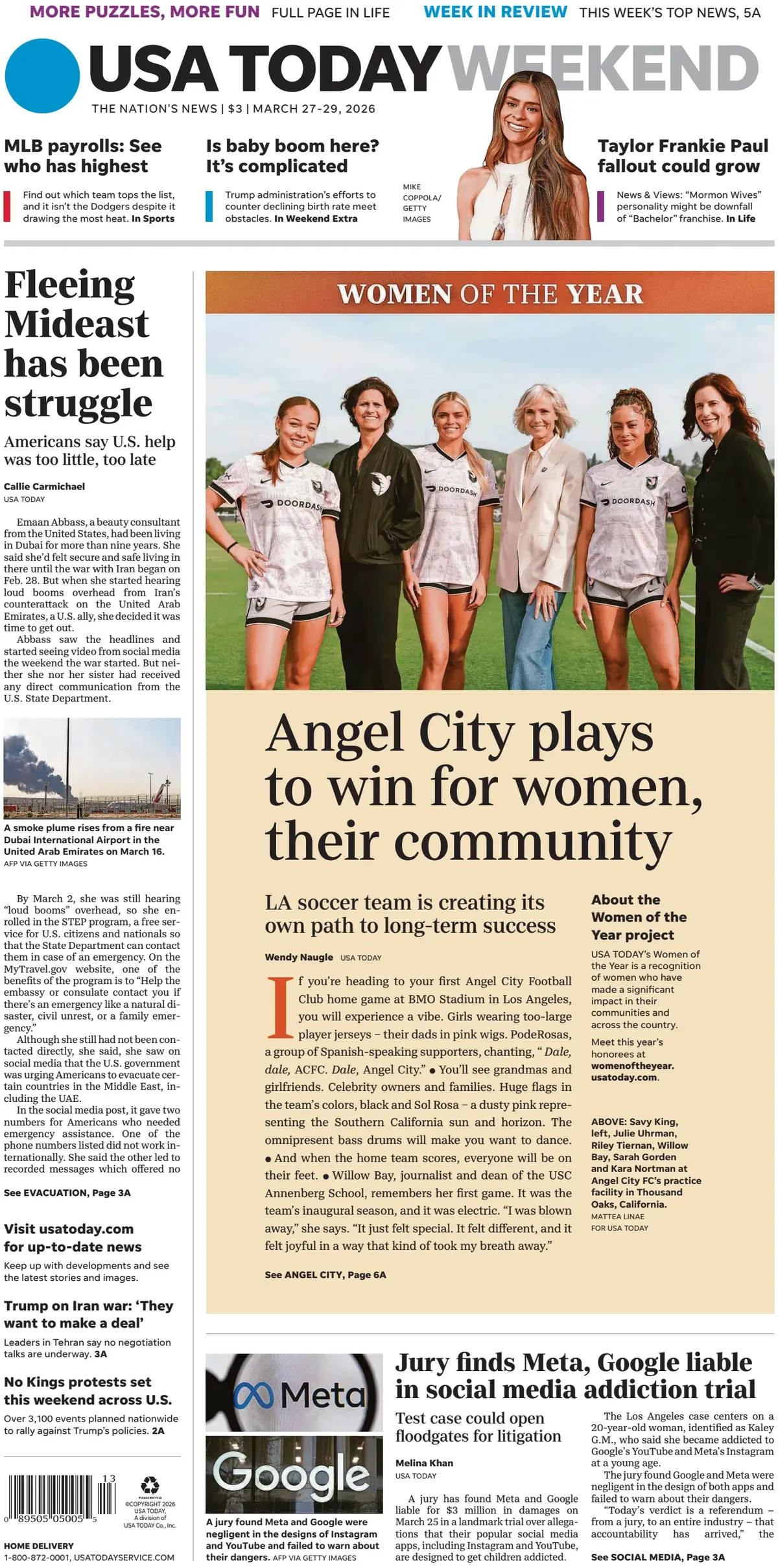
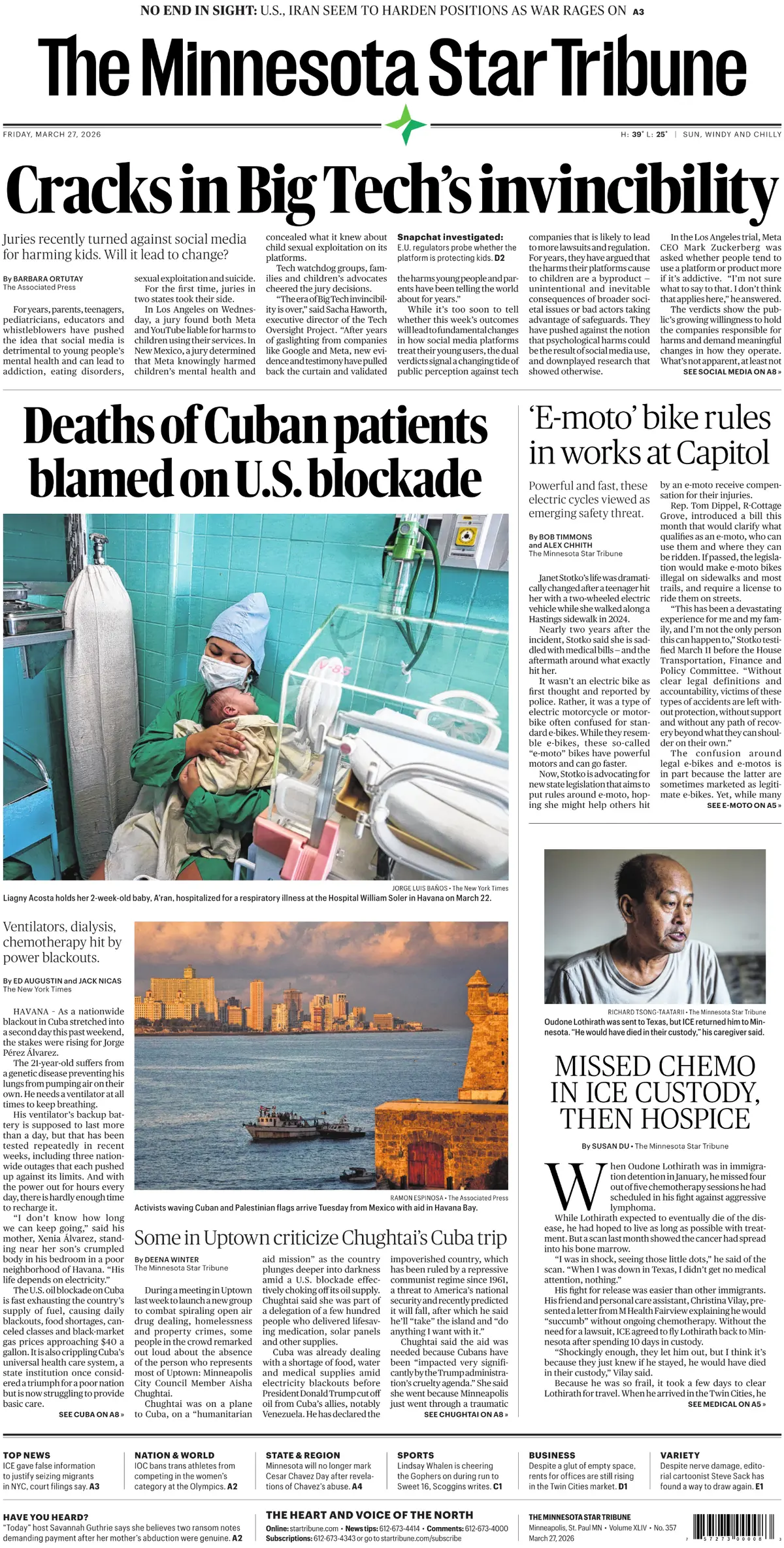
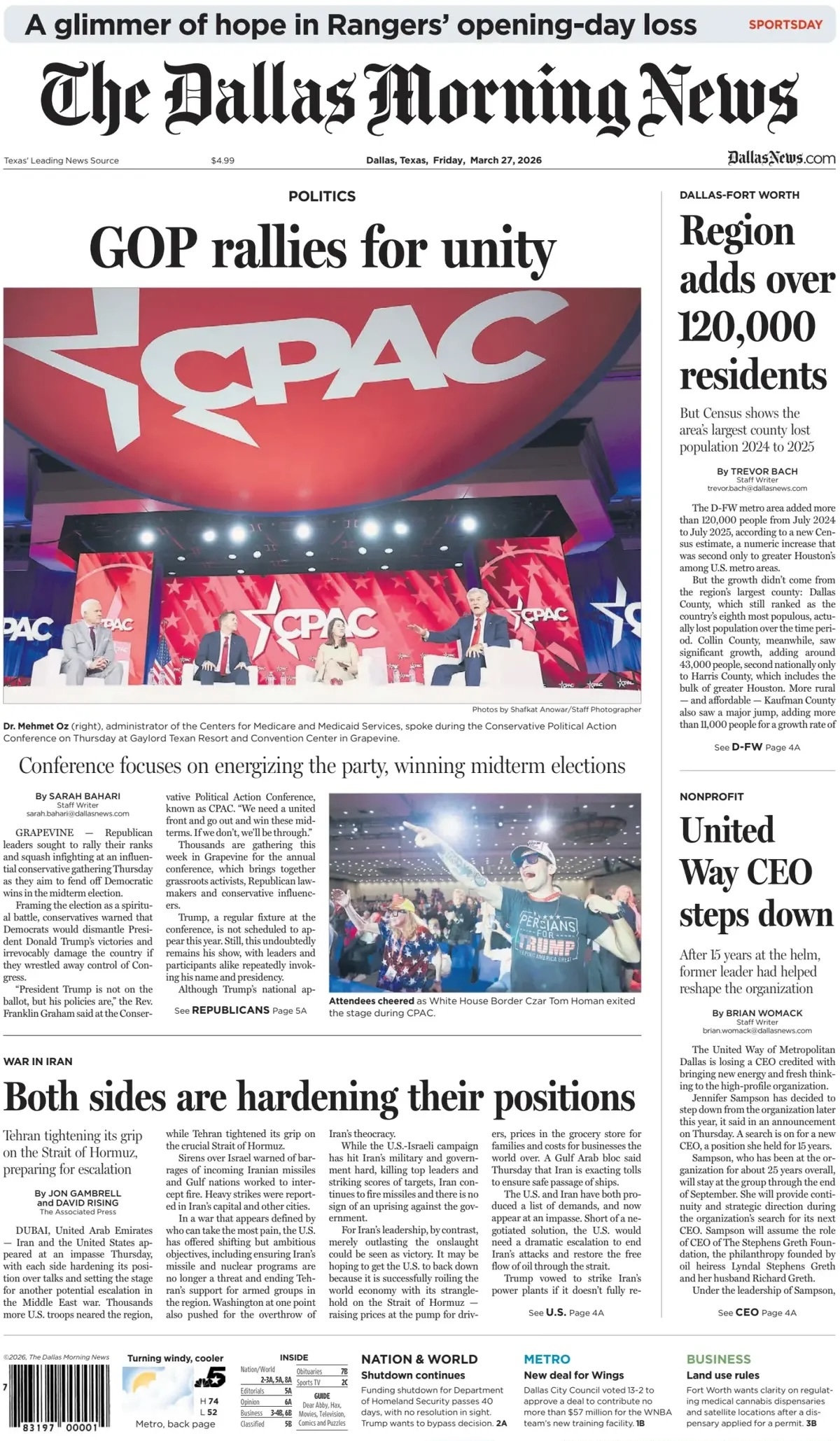
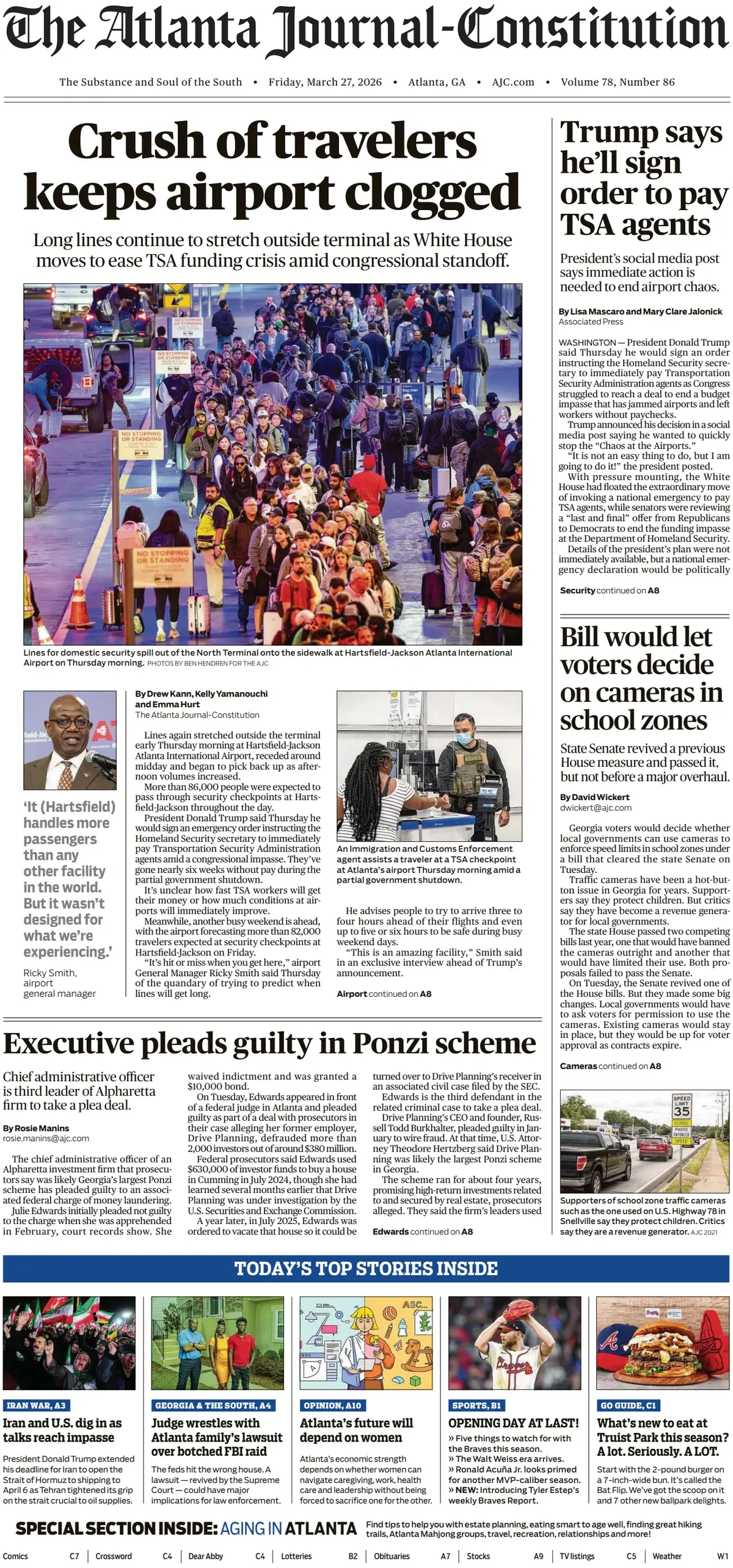
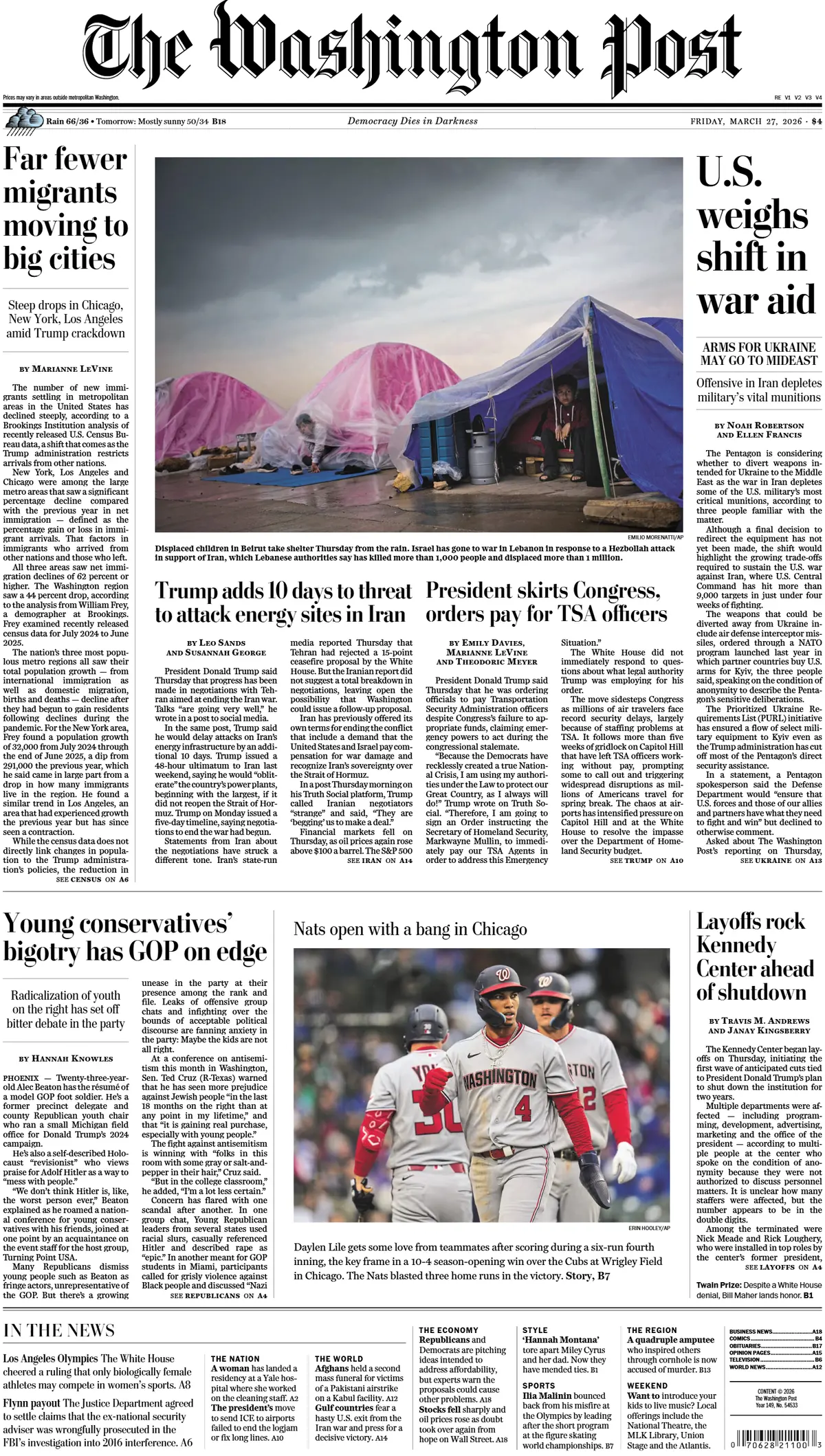
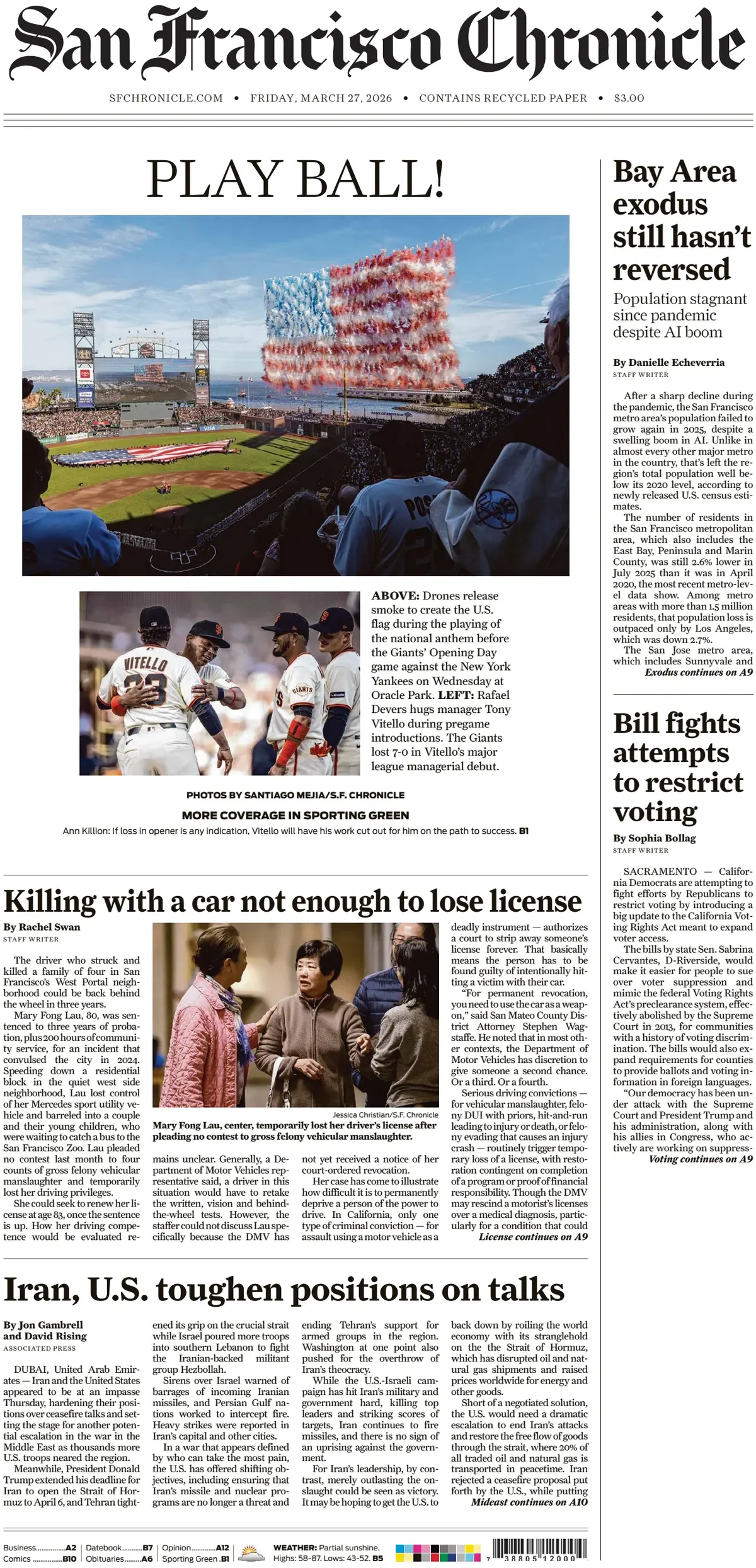
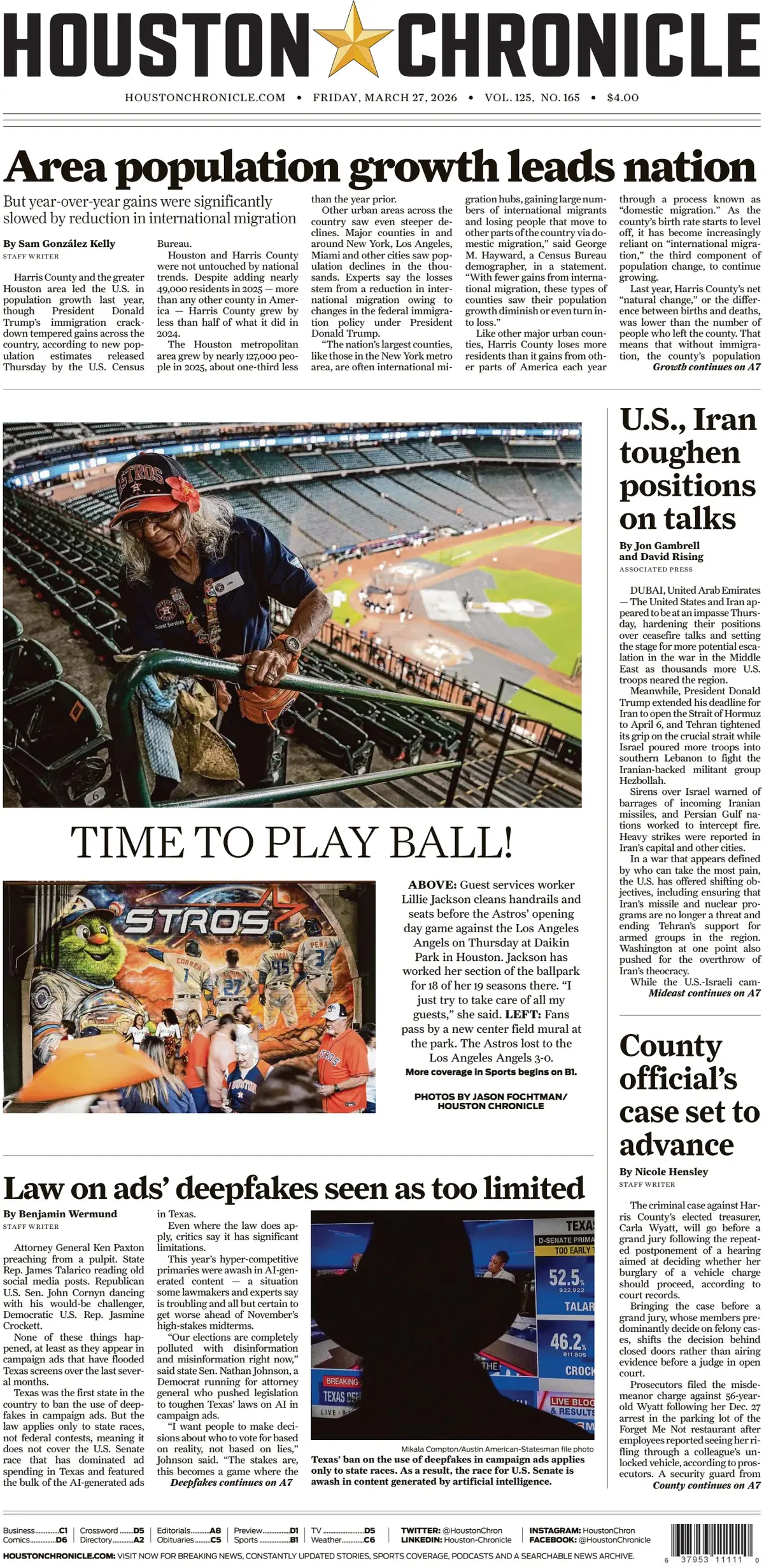
Trump renews threats, then extends deadline to reopen critical strait,” The New York Times says on Friday’s front page. “Conflict pushes Nasdaq down into correction” as Dow “poised for worst month since 2022,” The Wall Street Journal says. “War exit unclear,” the Los Angeles Times says. “Fleeing Mideast has been struggle,” and “Americans say U.S. help was too little, too late,” USA Today says. “Deaths of Cuban patients blamed on U.S. blockade,” The Minnesota Star Tribune says. “GOP rallies for unity,” The Dallas Morning News says. “Crush of travelers keeps airports clogged,” The Atlanta Journal-Constitution says. “Far fewer migrants moving to big cities,” The Washington Post says. “Bay Area exodus still hasn’t reversed,” says the San Francisco Chronicle. “Area population growth leads nation,” says the Houston Chronicle.
(Image credit: Los Angeles Times)
(Image credit: The New York Times) https://dutchrelay.com/regef7219c?key=d26f046d77045c805cf7655456802f03
(Image credit: The Wall Street Journal)
(Image credit: USA Today)
(Image credit: The Minnesota Star Tribune)
(Image credit: The Dallas Morning News)
(Image credit: The Atlanta Journal-Constitution)
(Image credit: The Washington Post)
(Image credit: San Francisco Chronicle)
Spring Outlook: Drought forecasted to expand in U.S. West, parts of Plains
Wildflowers bloom at Carrizo Plain National Monument on March 12, 2026, in Santa Margarita, California. California’s deserts and hills are seeing a colorful wildflower bloom this spring after a wet winter
According to NOAA's Spring Outlook, which was announced today for April through June, drought conditions are expected to intensify or develop in many parts of the West and south-central Plains. For much of the United States, NOAA's National Weather Service forecasters also anticipate above-average temperatures.According to Ken Graham, director of NOAA's National Weather Service, "the El Niño-Southern Oscillation (ENSO), low snowpack in the West, and soil moisture content throughout the lower 48 states are factors impacting NOAA's Spring Outlook." "There will also be a shift from La Niña to ENSO-neutral circumstances in spring, which means neither El Niño nor La Niña."
Based on short- and long-range statistical and dynamical estimates from March 19 to June 30, 2026, this map shows where drought persistence, development, or improvement is most likely to occur. (Photo courtesy of NOAA)
Download the picture
55% of the continental United States is experiencing moderate to severe drought conditions as of mid-March.
According to Jon Gottschalck, chief of the Operational Prediction Branch at NOAA's Climate Prediction Center, "warmer and drier than typical circumstances this winter aggravated or established drought conditions over much of the Great Plains, Lower Mississippi Valley, and Southeast U.S." "A significant portion of the Pacific Northwest, Great Basin, central Rockies, and Southwest are likely to experience drought, while the majority of the West is expected to continue experiencing it. Some parts of the Midwest and Atlantic coast are predicted to see an improvement in dry conditions.
Forecasts for temperature and precipitation
The bulk of the western United States, extending eastward to encompass much of the Plains, the lower and middle Mississippi Valley, the Ohio Valley, the Tennessee Valley, the Southeast, and the southern Mid-Atlantic, is expected to see above-normal temperatures in April and June, according to the temperature forecast. The Southwest to the Inter-Mountain West have the highest probability of increased warmth. East Central Alaska is expected to have below-average temperatures.
The Pacific Northwest, portions of the Great Basin, the Southwest, the middle High Plains, and the majority of the Rockies are expected to receive below-average precipitation. The Pacific Northwest to the middle Rockies are predicted to have the highest chance of below-average precipitation. Although precipitation in western Alaska is expected to be above average, the eastern
The areas where there is a higher than 50% likelihood of mild, moderate, or significant flooding between April and June of 2026 are shown on this map.(Photo courtesy of NOAA)
Download the picture
Current snowfall conditions, drought, soil saturation levels, frost depth, streamflow, and precipitation are all evaluated in NOAA's National Hydrologic Assessment, which is published by NOAA's National Water Center.
As of right now, the majority of the continental United States' overall flood risk is rated as normal to below average for spring 2026. The main reason for this risk assessment was a warm, dry winter that left most of the eastern United States with dry soils, reducing the risk of floods caused by rainfall. Additionally, a well-below-normal snowpack across most of the country will lessen the risk of snowmelt-driven flooding.
But as the lower Ohio Valley and the Red River of the North usually flood every year, flooding is expected in these basins this year as well.
According to Ed Clark, director of NOAA's National Water Center, "we anticipate ordinary spring flooding this year over areas of the Greater Mississippi River Basin, but the danger for widespread severe flooding is low." "But it is important to keep in mind that a significant flooding event could result from heavy rains."
Even in areas with a usually low danger, heavy rainfall can quickly cause flooding. Flood risk can fluctuate quickly, and rainfall location and intensity can only be precisely predicted days in the future. Use the most recent official watches to stay informed about the hazards of flooding in your area.




 Wildflowers bloom at Carrizo Plain National Monument on March 12, 2026, in Santa Margarita, California. California’s deserts and hills are seeing a colorful wildflower bloom this spring after a wet winter


Post a Comment